In the high valley, corn—twice as tall as any I have ever seen in eastern Washington—stalks the steep hillsides in a tightly planted phalanx surrounding the remote village community of Chitepey. The tasseled ears are a month away from harvest. There would be many lessons for me in Guatemala. What corn means to a family is only one. Everything you see tells you something: the story of the land, the people, the challenges of poverty and marginalization. Snaking the fields are slippery pathways, up and down, climbing hand-hoed stairs wide enough for our single-file procession to and from our base-camp at the village schoolhouse to the homes of families where we install externally-vented stoves to reduce the risk of acute respiratory infection in infants and young children. This is an altogether different form of elevation and the altitude sickness we are treating is not outside but inside of us in the forms of privilege, bias, patriarchy, righteousness. Unlike oxygen for expedition climbers, there aren’t any handy tanks filled with humility, simplicity, and compassion to help us along; “we make the road by walking (Antonio Machado),” and, it is a hard road ahead. The sound of rain on the broad leaves of corn as we walked through the fields is like nothing I have ever heard.
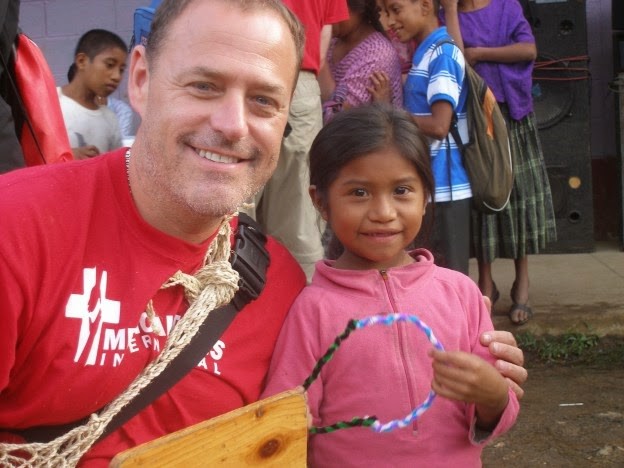
In the ancient Mayan creation story, the god of corn made the first humans. And so, I wonder, what the God of corn said to Lydia, one such young child, as she was gently made and walked into light and life? Did God speak to her of hunger and work, love and community? At 5 years old, she is no different and so different from any other girl her age. She is bare-footed, full of vibrant energy, curious, playful, shy yet eager to interact with the North American strangers. She is one of two girls in a family of 5 children and our team has time to improvise “head, shoulders, knees and toes” in their native language Q’eqchi which sends us all into fits of laughter. The children are remarkable, buoyant, and their smiles (as they tell me their names over and over again so I remember and pronounce them correctly) leap from their faces and explode in my heart like bright and colorful roman candles.
As it does for most of the school children in the community, Lydia’s education will end after sixth grade if not sooner. I try to remember what I was learning in sixth grade and whether or not it was adequate to prepare me for the rest of my life; and, I wonder what would have happened if my schooling, which has been so privileged, rich and diverse, ended abruptly at 6th grade. How do you channel your innate ability and drive for learning at age 10 or 11? Where does it go? There are no cars, no money for bus fare in this family, to take kids to the next level of school, never mind the health clinic–both about an hour away. How will the possibilities of Lydia’s young life unfold? How much of what I think about is rooted in my own preconceptions (what I want and believe should happen for Lydia) and the tacit privilege that I take for granted?
In Lydia’s home, there are two beds. The stove we installed is heating up. It will lower the health hazards of smoke and soot, burn less wood than an open fire in the kitchen, and save the family some money in the cost of firewood. Another lesson: Just because you are in the rain forest, doesn’t mean that wood is an abundant resource. What very little land a family owns is planted with corn, maybe some beans, a few stray coffee bushes, but no trees, unless you are blessed with a fruit-bearing tree like avocado. Land is needed to plant corn and beans—the fundamental staples upon which a family depends for survival. On these steep slopes, where torrential rainfall is a common occurrence, the hillsides lack the benefits of trees whose roots help to keep the threat of mud-slides at bay. Lydia’s mother forms a tortilla from masa ground on a sloped stone called a batan. This is how she feeds her family. It doesn’t take but a moment to see the bigger picture, although the full realization came much later for me. There is no electricity, no running water, no pantry hiding dry and canned goods, no refrigerated or frozen foods. Just a handful of plastic utensils and plates for a family of 7; a small jar of oil for the cook top, a few pots. I look around repeatedly but see no food aside from the corn being boiled to make masa. It is not quaint; not some romantic ideal of a simpler life that one may choose or wish for. It is stark poverty. And, when given the choice between poverty and what is truly adequate (not abundant), I doubt any parent would choose poverty and hunger for their children. The question of nutrition is secondary to hunger. Malnutrition is a critical problem that plagues children in these communities. And, while the government supplies the village with a kind of fortified porridge that the kids receive each day at school, it is unclear how this is anything but treading water in the middle of a wide sea. What happens to a family if their corn crop is poor? Some families have chickens, but not all do; and in the end, how many chickens are needed to sustainable feed a family of 7 with eggs or meat? The truth is far more complex than I had ever imagined: economic and political systems and structures which perpetuate marginalization and isolation, opportunity truncated by the lack of basic infrastructure (a road that doesn’t get washed out), severely limited access to healthcare, education, the basic goods of the earth. What is the status of those fundamental rights (food, shelter, safety, education, healthcare…) tied directly to the dignity and flourishing of the human person that we talk about in Catholic Social Teaching? Are they selective? Mandatory? Who decides? And, who speaks for Lydia? The first batch of tortillas on the new stove are successful and the family prays together to bless us and our “gift” to them before we move to the next home.
In a region where mortality in infants and children ages birth to 5 ranks 32nd in the world, where 14,000 children under 5 die each year, and where 48% of children suffer from moderate to severe “stunting” from malnutrition (UNICEF), something as simple as an externally vented stove is incredibly transformative—changing the way women in this family have cooked for decades if not centuries.
I see Lydia a few more times before we leave the village. The whole community turns out to thank and bless us, and to sing us safely on our way home, saying “although we are different, we come from one God.” My final memory of Chitepey is of Lydia, running along a small ridge by the school house as our bus pulled away, calling my name “Mateo, Mateo, Mateo.” And me calling back: “Lydia, Lydia, Lydia.” This is the moment I remember, far away at home in Seattle, which causes me to cry through the confusion of joy and sadness, beauty and terror that this experience has broken open in me.
And so, when I reflect on my experience and how it has touched me, I find no easy answer. Acts of service don’t always lend themselves to a condensed message neatly wrapped in words, but often overflow and resist every attempt to distill a key learning that can be passed on or cataloged. It is not a question of “having the experience but missing the meaning” (T.S. Eliot), but of a disruptive narrative that continues to arrive, unfold and multiply in meaning.
The unexpected truth for me is that this experience defies integration in the way that I am accustomed to, yet it carries the weight of an obligation, a responsibility. Integration in this sense forces me out into the open, into the clearing and clarity of a new awareness of how and why we are in the world, what love and compassion in each day hold up for us and our future. I cannot pretend about or hide from the privilege that permeates my context, but I can allow and embrace the reshaping of my understanding of community, poverty, vulnerability, hope, generosity, charity, and liberation. For now, I acknowledge with gratitude the seeds of understanding and transformation that this new awareness has sown in my life.
The path we take, through cornfields in Guatemala, or to love, friendship, career, family, is never a straight line; there are many turns, returns and detours in a journey where the end is simultaneously known yet hidden from us. Often on faith, we wind our way in life through the elation and conflation of life events—openings to the deeper meaning of our lives formed across the diminishing expanse of time situated between so many endings and beginnings which are abrupt, painful, quiet, joyful: the birth of a child, the loss of a loved one, a first kiss, a sacred calling, successes and failures. These are events that wake us up, throw us back into ourselves, and ask us who we are. Isn’t this what it means to be called? To be woken up by a voice in the night of your everyday, to be called by your own name?
A profoundly irrevocable waking moment for me was having my name called by a little girl named Lydia.
God speaks to each of us as he makes us, then walks with us silently out of the night.
These are the words we dimly hear:
You, sent out beyond your recall, go to the limits of your longing. Embody me.
Flare up like flame and make big shadows I can move in.
Let everything happen to you: beauty and terror. Just keep going. No feeling is final.
Don’t let yourself lose me.
Nearby is the country they call life. You will know it by its seriousness.
Give me your hand.
Rainer Maria Rilke
Rilke’s Book of Hours: Love Poems to God (translated by Anita Barrows & Joanna Macy. New York: Riverhead Books, 2005)

